
From Brief to Installation: How Bespoke Artwork Is Commissioned
Commissioning bespoke artwork can appear daunting if you have never done it before. How developed does the initial idea need to be? What happens if the client wants changes? How closely should the artwork match the interior? And who deals with framing, delivery and installation?
In practice, a successful commission is a structured collaboration. The interior designer brings an understanding of the space, the client and the wider scheme. The artwork studio translates that information into something original, practical and appropriate for its setting.
The result should not feel like decoration added at the end. It should feel as though it has always belonged in the interior.
Here is how the bespoke artwork process typically develops, from the first conversation to the final installation
1. Understanding the brief
Every commission begins with the space rather than the artwork.
Before developing ideas, we need to understand where the piece will be positioned, how it will be viewed and what role it needs to play. Artwork for a hotel reception has a different purpose from a collection for guest bedrooms, a feature piece in a restaurant or a painting for a private residence.
A useful initial brief might include:
- Interior elevations, plans or photographs
- Approximate artwork dimensions
- Visual references or concept boards
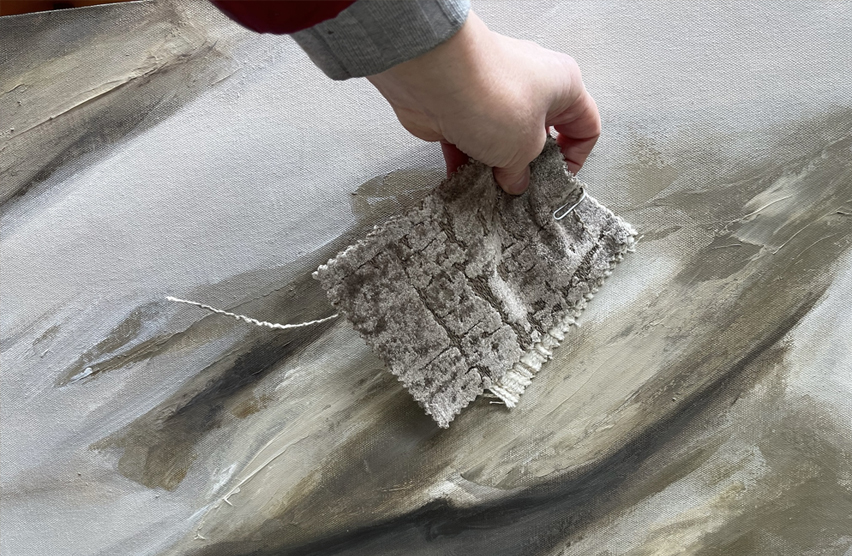
- Fabric, paint and material samples
- The required mood or atmosphere
- Framing and glazing preferences
- The number of artworks required
- Project timescales and installation dates
- Any practical or access restrictions
The brief does not need to contain a finished artwork idea. Some designers come to us with a clear visual direction; others have a colour palette, a few references and a wall that needs resolving. Both are perfectly workable starting points.
3. Establishing size, materials and budget
The creative direction cannot be separated from the practical specification.
The dimensions of the wall, nearby furniture, sightlines and ceiling height all influence the appropriate scale. A piece that looks substantial in isolation may appear undersized once placed above a long console or within a double-height space.
Materials also affect the appearance, weight and cost. Options might include:
- Original paintings on canvas, or on a panel
- MDF-faced stretchers for a cleaner, more rigid surface
- Giclée or digitally produced prints
- Layered mixed-media artwork
- Cast or fabricated sculptural reliefs
- Timber, metal or upholstered elements
- Framed works with standard or specialist glazing
Where a project includes numerous locations, the artwork package can combine statement pieces with more economical repeatable formats. This allows the available budget to be focused on the most important spaces while maintaining a consistent visual language throughout the scheme
4. Developing the initial concepts
Once the general direction has been agreed, we normally produce rough digital sketches or visual mock-ups.
These are not intended to represent every brush mark or surface detail in the finished piece. Their purpose is to establish the main composition, proportions, colour balance and relationship with the interior.
Where elevations or good-quality room photographs are available, the proposed artwork can often be shown in position. This helps the designer and client judge the scale and impact far more accurately than viewing an isolated image.
For a collection, the concepts also show how the pieces work together. The aim is usually to create a sense of connection without making every artwork look the same
5. Refining and approving the direction
The concept stage is the best time to make changes.
The designer may want a colour reducing, a shape repositioning or one composition to feel quieter than another. These refinements are much easier to accommodate before the finished artworks have been produced.
Clear, consolidated feedback is particularly valuable. When comments from the designer, client and other stakeholders are gathered into one response, the project can move forward efficiently and with less risk of conflicting instructions.
It is also helpful to agree in advance how many rounds of revisions are included. Setting this expectation at the outset helps everyone understand the review process and keeps the project moving. If further changes are needed beyond the agreed number of rounds, they can be discussed separately in terms of timing and cost.
Colour should be handled carefully. Screens and digital images display colour differently, so physical fabric, paint or material samples should be supplied whenever an accurate relationship is important. Digital visuals can indicate the overall direction, but they cannot guarantee an exact physical colour match.
Once the composition, palette and general approach have been approved, production can begin.
6. Creating the finished artwork
This is where the character of the finished piece emerges.
A handmade artwork will naturally develop during production. Texture, layering, brushwork and small variations cannot—and should not—be completely predetermined in a digital sketch. That element of artistic interpretation is what prevents the finished work from feeling mechanical.
The approved concept establishes the direction, but enough creative freedom must remain for the artist to respond to the materials and scale of the piece.
For sculptural or mixed-media work, production may involve mould-making, casting, CNC cutting, fabrication, assembly and specialist spray finishes. Repeatable pieces can still be customised through colour, surface treatment, layout or the way individual elements are arranged
7. Reviewing the completed work
Once the artwork is complete, photographs are supplied for approval before it proceeds to framing or final preparation.
Images are usually taken square-on and, where useful, include close-up views to show texture and surface detail. This gives the designer and client an opportunity to review the finished piece before it leaves the studio.
It is worth remembering that photographs cannot entirely reproduce the depth, colour and texture of an original artwork. Nevertheless, they provide an effective final approval stage and allow practical details to be confirmed before framing
8. Selecting the frame and glazing
The frame should support both the artwork and the interior without overpowering either.
Depending on the project, this might be a simple tray frame, a stained timber profile, a slim metal frame or a more traditional moulding with a mount. Some contemporary paintings work better unframed, particularly when produced on a deep support with carefully finished edges.
Glazing also needs consideration. Standard glass may be suitable for many works on paper, while anti-reflective Artglass can improve clarity for important pieces. Acrylic glazing can reduce weight and may be preferable in locations where safety is a concern.
The overall depth and weight of the finished piece will determine the most appropriate hanging system.
9. Planning delivery and installation
Installation should be considered from the beginning, especially for large, heavy or multi-part pieces.
Before delivery, it may be necessary to confirm:
- Wall construction and suitable fixings
- Access routes, lifts and door sizes
- Finished floor and furniture levels
- The position of lighting, switches and other fittings
- Working-hour or site-access restrictions
- Whether specialist lifting equipment is required
Smaller framed pieces may arrive ready for the client’s contractor to hang. More complex work is often best installed by the artwork studio or an experienced installation team. This ensures that the spacing, level and final arrangement match the approved design
10. The final result
The strongest bespoke artwork does more than fill an empty wall. It can establish a focal point, connect the colours and materials within a room, reinforce a brand or create a sense of place.
Achieving that result depends on both creativity and organisation. A clear brief, timely feedback, realistic programme and early consideration of framing and installation all help the commission run smoothly.
At Artistic Licence, we work with interior designers, architects, property developers and private clients to create original paintings, bespoke prints, mixed-media pieces and sculptural wall installations. We can manage the complete process—from the initial concept and digital visuals to production, framing, delivery and installation.
If you are considering commissioning artwork for an interior design project, send us your elevations, room photographs or initial ideas. We can help develop the brief, recommend suitable materials and create an artwork proposal tailored to the space
Frequently asked questions
How early should artwork be considered in an interior design project?
Ideally, artwork should be discussed while the interior scheme is still being developed. Early involvement gives more freedom over scale, materials, lighting, wall construction and installation. However, we can also develop artwork for completed interiors.
Does the client need to know exactly what they want?
No. Visual references, colour samples and information about the space are often enough to begin. Part of the commissioning process is interpreting these elements and turning them into a clear creative direction.
Can bespoke artwork match an interior colour scheme?
Yes, artwork can be developed to complement specified fabrics, paints and finishes. Physical samples should be supplied when accurate colour coordination is important, as colours displayed on screens can vary considerably.
Can you produce artwork for an entire hotel or development?
Yes. A larger package can include original statement pieces, bespoke prints, framed collections and sculptural work. Using a mixture of formats makes it possible to create variety while maintaining consistency across the project.
Can Artistic Licence arrange framing and installation?
Yes. Artwork can be supplied framed and ready to hang, and installation can be arranged where required. The appropriate approach will depend on the scale, weight, location and complexity of the work.